Educational editorial content by Rowenda Kitchen team. Last updated November 2025.
Key elements of modern kitchen design: a practical guide for Malaysian homes
By Rowenda Kitchen Editorial Team
Modern kitchen design blends innovative layout, smart technology, sustainable materials, and contemporary trends. This guide covers the 15 elements that turn a kitchen from a cooking space into the heart of contemporary living — adapted for Malaysian climate, kitchen workflow, and tropical-taste preferences.
Why modern kitchen design matters in Malaysia
Modern kitchen design centres on blending form and function to create cooking spaces that cater to today's lifestyle. The importance of a well-designed kitchen lies in its ability to offer efficiency, comfort, and visual appeal — key factors that influence how often and how well a kitchen is used. Whether for private residences or commercial spaces, adopting a modern kitchen approach establishes a foundation for long-term satisfaction and property value.
For Malaysian homes specifically, modern design needs to address tropical climate, varied cooking styles (Chinese, Malay, Indian, Western), and the trend toward open-plan living in condos and landed homes. The decisions below are ordered by impact — layout first, decoration last.
1. Colour schemes that anchor the design
Choosing the right colour scheme sets the mood and aesthetic resonance for any modern kitchen. Neutral tones like whites, greys, and soft beiges are dominant in simple modern kitchen designs, as they promote a clean, timeless look. For luxury modern kitchen designs, deeper hues like navy, emerald, or charcoal contrast beautifully with metallic finishes, creating visual depth. Accent colours introduced via backsplashes or cabinet handles add personality without overpowering the space.
Practical note for tropical climates: lighter colours make kitchens feel cooler and show less cooking residue. Matte finishes hide fingerprints better than gloss on high-touch cabinet doors.
2. Functional layouts: the work triangle
A core principle in modern kitchen design is the work triangle, which optimises movement between the sink, stove, and refrigerator. This layout reduces unnecessary steps and streamlines cooking activities. Implementing this concept varies depending on kitchen size; in modern kitchen design small space scenarios, a compact but effective triangle ensures efficiency without crowding.
For Malaysian condo layouts, the work triangle often has to bend around doorways, windows, and structural walls. The result is still a triangle — but a bent one. L-shaped and U-shaped layouts are the most common solutions for KL condos with this constraint.
3. Modern appliances and technology integration
Smart technology is integral to contemporary kitchens, from energy-efficient appliances to voice-controlled ovens. The latest modern kitchen cabinets design now incorporates built-in charging stations, hidden appliance garages, and LED lighting. This integration increases convenience and fosters a seamless cooking experience, marrying innovation with everyday usability.
For Malaysian homes, the highest-impact tech upgrades are built-in steam ovens (for Asian cooking), induction cooktops (cooler kitchen, safer with children), and integrated range hoods with sufficient CFM for wok cooking. Smart features are nice-to-have, but extraction power is non-negotiable.
4. Sustainable materials and eco-friendly design
Sustainability is a cornerstone of modern kitchen ideas, driving demand for eco-friendly materials such as bamboo, recycled glass countertops, and low-VOC paints. These materials not only reduce environmental impact but also enhance indoor air quality. Developers and homeowners increasingly prefer sustainable solutions which support both function and responsible living.
Rowenda's Green Kitchen Series applies this principle at scale — FSC and PEFC certified boards, European E1 low-formaldehyde standards, and manufacturing processes that prioritise recycling and waste reduction. For households with children or asthma, the indoor air quality improvements are measurable.
5. Lighting solutions for contemporary kitchens
Lighting plays a pivotal role in modern kitchen design. Layered lighting strategies — including recessed lights, task lighting under cabinets, and ambient ceiling fixtures — create an inviting and adaptable atmosphere. Proper lighting highlights key areas like prep zones and displays while contributing to energy savings through the use of LED technology.
For Malaysian kitchens, plan for at least three lighting zones: ambient (ceiling), task (under-cabinet LED strip), and accent (pendant over island). The third zone is where Malaysian kitchens often fall short — pendants are decorative and skipped for budget reasons, but they define the visual centre of the room.
6. Storage solutions: maximising kitchen space
Maximising storage is essential, especially in small modern kitchen design contexts. Innovative solutions include pull-out pantry shelves, vertical dividers, and corner carousels inside modern kitchen cabinets. These designs enhance organisation and accessibility, reducing clutter and optimising every inch of space.
Three high-impact storage upgrades for Malaysian homes: pull-out spice racks beside the cooktop, vertical tray dividers for baking sheets and cutting boards, and tiered drawers for saucepans. Each addresses a specific Malaysian cooking pain point.
7. Open concept vs. closed kitchen design
Open concept kitchens foster connectivity with living and dining areas, ideal for social and family interactions. In contrast, closed kitchens offer privacy and contain cooking odors and noise. The choice depends on lifestyle and space constraints, but both approaches can be executed using modern kitchen ideas that emphasise clean lines and minimalism.
For Malaysian heavy cooking, a fully open layout is often impractical — heavy spice and wok cooking spreads through the living area. The semi-open layout with a sliding glass partition or solid swinging door is the most common compromise that keeps the social feel while containing cooking impact.
8. Trends in kitchen countertops and backsplashes
Quartz, granite, and recycled glass are trending countertop materials in modern kitchens for their durability and aesthetic appeal. Backsplashes often complement countertops with subway tiles, large-format slabs, or reflective glass surfaces. These materials combine to provide a striking yet practical focal point that aligns with overall design themes.
For Malaysian humidity, engineered quartz is the practical choice over marble — it does not require sealing and resists staining from soy sauce, turmeric, and palm oil. Granite is the natural alternative at lower cost.
9. Integrating smart home features in the kitchen
Beyond appliances, modern kitchen designs integrate smart home systems for lighting, security, and climate control. Voice assistants and app-controlled devices allow homeowners to manage kitchen environments effortlessly. This integration epitomises the future of kitchen convenience and energy efficiency.
The most useful smart home integrations for Malaysian kitchens are voice-controlled lighting (hands-free when both hands are wet or holding a wok), smart leak sensors under the sink, and app-based hood speed control. Expensive smart fridges are less useful than these small, practical upgrades.
10. The role and design of kitchen islands
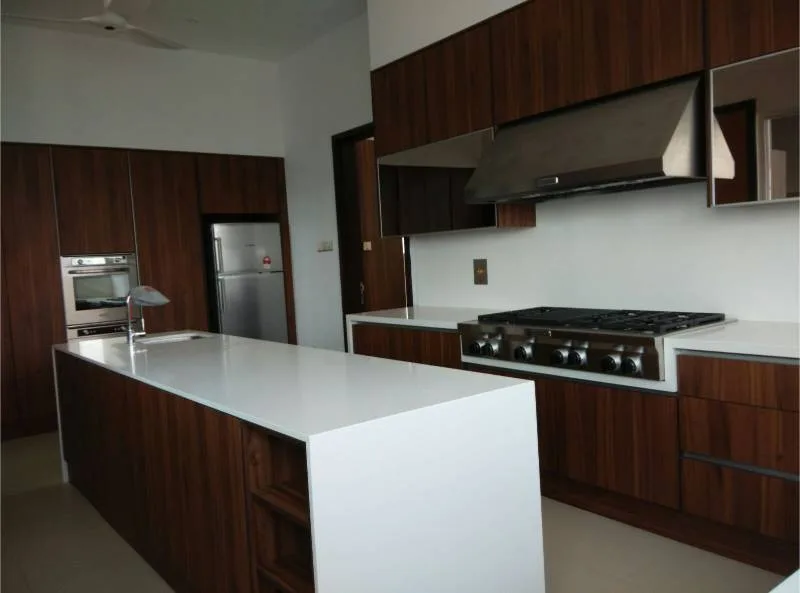
Kitchen islands serve multiple purposes, from additional prep space and storage to informal dining areas. In luxury modern kitchen designs, islands often feature integrated sinks, cooktops, or seating, making them central hubs for both cooking and entertaining. Selecting materials and finishes that complement existing cabinetry enhances cohesiveness.
For Malaysian homes, the island is the social anchor of the kitchen. A waterfall-edge quartz island with bar seating for two or three is the most requested configuration in 2025. For smaller kitchens, a peninsula variant gives the same social advantage without losing circulation.
11. Choosing cabinet styles and finishes
Cabinet style defines the kitchen's character. Modern kitchen cabinets often feature flat-panel doors with minimal hardware for a sleek, streamlined look. Finishes range from matte and glossy lacquers to wood veneers, supporting tailored aesthetics from contemporary minimalism to warm, natural tones. Proper selection ensures durability and matches the overall design intent.
Hardware is the detail that defines modern most clearly. Push-to-open mechanisms, integrated handles, and slim bar pulls are the three options that read as modern. Knobs and cup pulls push the look toward classic or transitional.
12. Importance of ventilation in modern kitchens
Effective ventilation is vital to maintain indoor air quality and comfort, removing cooking odors and airborne grease. Modern solutions include downdraft vents, ceiling-mounted range hoods, and energy-efficient exhaust fans. Well-planned ventilation improves the kitchen environment, protecting finishes and reducing maintenance.
For Malaysian cooking, plan for at least 1,500 CFM extraction with a hood that extends over the entire cooktop area. Recirculating hoods (with carbon filters) are not adequate for Malaysian heavy cooking — they should only be a last resort when ducting is impossible.
13. Incorporating personal style and aesthetics
While functionality is paramount, a modern kitchen should reflect personal taste. This can be achieved through unique backsplashes, bespoke cabinet handles, or curated décor elements. Balancing trend-driven designs with timeless touches ensures a kitchen that remains stylish and inviting over time.
The most successful modern Malaysian kitchens balance the trend-driven elements (pendant lights, tile patterns) with the timeless elements (cabinet construction, drawer slides, hinges). When the trend changes, the timeless elements stay — only the accents get updated.
14. Plumbing and electrical considerations
Modern kitchen designs require careful planning of plumbing and electrical systems to accommodate advanced appliances and fixtures. Installing sufficient electrical outlets, dedicated circuits for heavy appliances, and efficient water supply and drainage systems supports seamless operation and safety.
Most Malaysian kitchen renovations require electrical upgrades — older condos and landed homes often have insufficient dedicated circuits for ovens, induction cooktops, and instant water heaters. This is the most common source of mid-project surprises. Plan an electrical audit before cabinetry design.
15. Future trends in kitchen design
Emerging trends emphasise sustainability, automation, and personalisation. Expect to see more renewable materials, AI-powered appliances, modular cabinetry, and adaptable layouts catering to flexible lifestyles. These innovations promise to keep modern kitchens at the forefront of design and technology.
The most practical trend for 2025-2026 in Malaysia is modular cabinetry — systems that can be reconfigured or extended as household needs change. This protects your investment when families grow, lifestyle shifts, or cooking habits evolve.
Frequently asked questions
What is the most important element in modern kitchen design?
Functional layout based on the work triangle (sink, stove, refrigerator). All other elements — colour, lighting, cabinetry, technology — serve the workflow. Without good layout, those upgrades become expensive decorations.
How do I choose a colour scheme for my modern kitchen?
Start with neutrals (white, grey, soft beige) for the cabinetry base. Add accent colours through backsplashes, handles, or one feature wall. For luxury modern kitchens, deeper hues like navy, emerald, or charcoal pair well with metallic finishes.
What is the work triangle in kitchen design?
The spatial relationship between sink, stove, and refrigerator. Total perimeter should be 12-26 feet (3.7-7.9m). Less than 12 feet means cramped movement; more than 26 feet means wasted steps during cooking.
Are smart kitchen appliances worth the investment?
For daily-use households, smart appliances pay off in energy efficiency and convenience. Voice-controlled ovens, app-connected refrigerators, and integrated charging stations increase real-world usability. For occasional-use kitchens, basic appliances are sufficient.
What sustainable materials are best for modern kitchens?
Bamboo, recycled glass countertops, low-VOC paints, and FSC-certified engineered wood. These reduce environmental impact and improve indoor air quality. Malaysian kitchens specifically benefit from boards with low formaldehyde emissions (European E1 standard).
Should I choose open or closed kitchen design?
Open concept kitchens suit social and family-oriented households. Closed kitchens contain cooking noise and odours. For Malaysian-style heavy cooking, a semi-open layout with a sliding glass partition is often the practical compromise.
How important is ventilation in modern kitchens?
Critical in Malaysian cooking. Plan for at least 1,500 CFM extraction with a hood that extends over the entire cooktop area. Recirculating hoods with carbon filters are a last resort — they are not adequate for heavy cooking.
From insight to a working design
Reading about modern kitchen design is the easy part. Translating the 15 elements above into a working layout for your specific home — with Malaysian condiments, your appliance sizes, your household cooking patterns — is where the real work happens. Rowenda has designed and manufactured modern kitchens for KL and Selangor homes since 1984. The 4-step process covers free consultation, on-site measurement, 3D design, and full installation by in-house fitters.
If you want to see how modern kitchens look in Malaysian homes, the Rowenda design services page has full galleries of modern, contemporary, classic, and built-in projects. The aluminium kitchen cabinets page covers the material-direction option for households prioritising humidity resistance.