
Sub-pillar
Bespoke built-ins, scoped for day-to-day use
The process starts with room behavior and storage friction. Then we map dimensions, front profile, and finishing options around that logic.
Plan custom furniture build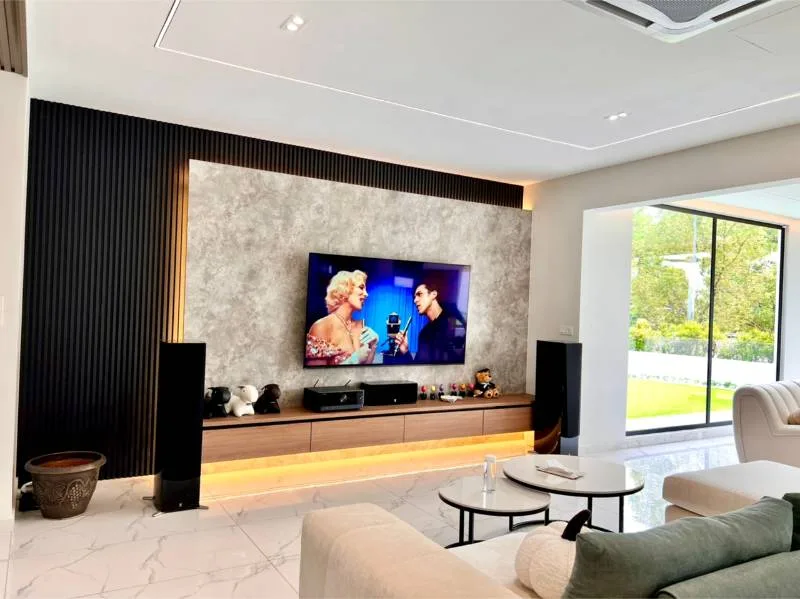
Sub-pillar
The process starts with room behavior and storage friction. Then we map dimensions, front profile, and finishing options around that logic.
Plan custom furniture buildWhat the process looks like
The bespoke built-in process starts with a room-level conversation, not a furniture catalogue. We want to know what the room is for now, what it was for before, what is not working, and what would feel like an upgrade. For a TV wall, the questions are about viewing distance, equipment, cable management, and how the family actually uses the space (is it background TV or a focal point?). For a study, the questions are about work habits, equipment, lighting, and storage. The brief is the most important step, and the one that most contractors skip.
After the brief, we measure the room (twice for accuracy) and produce layout options. For a TV wall, the options might be a low-slung single-cabinet version, a full-wall storage version, and a hybrid with display and closed-storage split. For a study, the options differ on whether the desk is fixed or movable, whether storage is above or beside the desk, and whether the joinery integrates with existing room features. Each option has different cost and timeline implications, and the choice sets the direction for the rest of the project.
Once the layout is agreed, we produce the 3D render and final specifications — dimensions, hardware, materials, finishes. The factory uses these to fabricate, and the installer uses them on site. Production typically takes 3-4 weeks for a single bespoke piece, and installation is usually 1-2 days. The whole process from first meeting to handover is typically 6-8 weeks for a single piece, longer for full-home built-in packages.
Where bespoke beats ready-made
Where ready-made is fine
Not every project needs bespoke. A standalone bookshelf in a regular rectangular room, with no unusual equipment or storage requirements, is usually served well by an off-the-shelf product from IKEA, MR.DIY, or a local furniture shop. The cost difference between ready-made and bespoke for a simple piece is 3-5x, and the value of bespoke is only realised when the room or the use case has something off-standard about it. The second case is when the homeowner expects to redecorate frequently. A bespoke piece is a 10-15 year commitment; if the homeowner redecorates every 3 years, ready-made is the better economic choice. The third case is when the project is truly small (a single shelf, a small cabinet) — the design and installation overhead of bespoke is hard to justify for a tiny piece.
Pricing and timeline
A bespoke built-in piece is typically priced by linear foot or by square foot, with the rate depending on the material, the internal complexity, and the finish. A standard TV wall in melamine-faced plywood runs about RM 800-1,200 per linear foot. A higher-spec TV wall with HPL fronts, integrated lighting, and a feature panel runs RM 1,400-1,800 per linear foot. A full-wall storage piece with a desk, display cabinets, and closed storage runs RM 1,200-2,000 per linear foot depending on the configuration. For a typical 8-foot TV wall, that is RM 6,400-16,000 for the piece itself, before considering any electrical or finishing work.
Production is typically 3-4 weeks from design sign-off for a single piece, longer for a full-home package. Installation is usually 1 day for a single piece and 2-3 days for a multi-piece package. The full project timeline from first meeting to handover is 6-8 weeks for a single piece and 10-14 weeks for a full-home package. The biggest scheduling risk is delays in the design sign-off, which push the production start back by the same amount. Homeowners who prepare their brief in advance and respond quickly to design drafts keep the project on schedule.